
In modern biotechnology and pharmaceutical production, biofermentation generates nutrient‑rich broths laden with valuable proteins, enzymes, and metabolites. Efficient downstream separation is vital to recover these compounds at high purity and yield. A low temperature evaporator offers an elegant solution—concentrating and clarifying fermentation supernatants under gentle conditions that safeguard sensitive biomolecules.
1. The Challenge of Biofermentation Broth
Fermentation media contains:
- Heat‑labile components (enzymes, growth factors)
- Cells and debris that must be removed without shear damage
- High water content, requiring volume reduction for downstream polishing
Conventional high‑temperature evaporation risks protein denaturation and fouling, leading to loss of activity and costly downtime.
2. Why Choose a Low Temperature Evaporator?
By operating under vacuum at temperatures between 20–50 °C, low temperature evaporators enable:
- Gentle water removal without overheating
- Preservation of bioactivity, maintaining enzyme function and protein structure
- Reduced fouling, since cooler surfaces discourage scale formation
- Energy savings, leveraging lower thermal gradients and optional multi‑effect or vapor recompression
This makes them ideal for the critical concentration step immediately following cell separation and clarification.
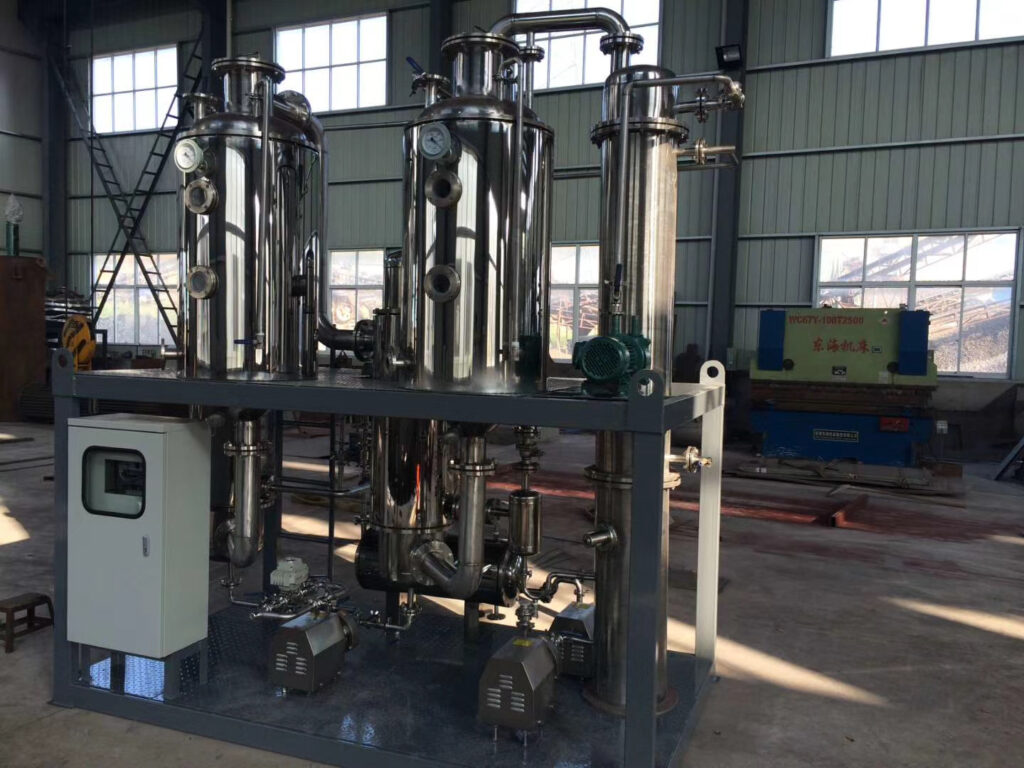
3. Key Features for Biofermentation Separation
A biotech‑grade low temperature evaporator includes:
- Thin‑film or falling‑film design: Maximizes surface area for fast evaporation and minimal residence time.
- Corrosion‑resistant construction: 316L stainless steel and pharmaceutical‑grade seals withstand CIP/SIP cycles.
- Automated temperature & vacuum control: PID‑driven loops maintain precise setpoints, preventing thermal spikes.
- Integrated solids removal: Pre‑evaporation filtration or decanter modules can be added to protect the evaporator tubes.
- Clean‑In‑Place (CIP) capability: Ensures rapid, hygienic cleaning without disassembly, reducing downtime.
4. Process Integration and Benefits
Workflow:
- Cell removal: Centrifuge or microfiltration removes biomass.
- Pre‑clarification: Optional depth filtration to eliminate fine particulates.
- Low temperature evaporation: Concentrates the clarified supernatant to target solids.
- Polishing: Final purification—ultrafiltration or chromatography—becomes more efficient at higher solids.
Benefits:
- Higher product concentration reduces downstream volumes by up to 80%.
- Improved purity lowers the load on polishing steps, boosting overall throughput.
- Energy efficiency with up to 40% lower steam usage versus traditional evaporators.
- Scalability from pilot to full production with modular skid‑mounted units.
5. Real‑World Application Example
A mid‑scale pharma producer implemented a multi‑effect low temperature evaporator after fermenting a recombinant enzyme. By lowering evaporation temperature to 45 °C and recovering vapor heat across three effects, they achieved:
- 60% reduction in steam consumption
- 95% retention of enzyme activity
- 30% faster batch turnaround due to reduced fouling and quick CIP
For any facility seeking to optimize post‑fermentation separation, a low temperature evaporator provides a balance of gentle processing, high efficiency, and robust hygiene. By integrating this technology, biotech and pharmaceutical manufacturers can boost yields, protect product integrity, and cut energy costs—all while meeting stringent regulatory standards.