
Choosing the right evaporator system is critical for process efficiency and cost control in industries like food, pharmaceuticals, chemicals, and wastewater treatment. Two common options—single effect evaporator and multi-effect evaporator—serve similar purposes but differ significantly in performance, complexity, and use cases.
In this article, we break down the 5 core differences to help you make an informed decision.
1. Energy Efficiency
- Single Effect Evaporator: Uses steam once to evaporate water or solvent. It’s straightforward but typically consumes more energy per unit of evaporation.
- Multi-Effect Evaporator: Reuses the vapor from one effect to heat the next. It significantly reduces steam consumption, often by 50–70%, making it ideal for energy-sensitive operations.
✅ Verdict: Multi-effect systems are more energy-efficient, especially for large-scale or continuous operations.
2. System Complexity
- Single Effect: Features a simple design with fewer components—ideal for basic evaporation needs and easier to operate.
- Multi-Effect: Includes multiple stages, interconnecting piping, and sometimes thermal vapor recompression (TVR), which increases complexity.
✅ Verdict: Single-effect evaporators are easier to install, run, and maintain, especially in small factories or pilot plants.
3. Initial Investment and Cost
- Single Effect: Lower capital cost due to minimal equipment and infrastructure requirements.
- Multi-Effect: Higher initial cost due to added stages, steam distribution, and instrumentation—but potential long-term savings through reduced energy bills.
✅ Verdict: Single-effect evaporators are more budget-friendly for short-term or small-batch processing.
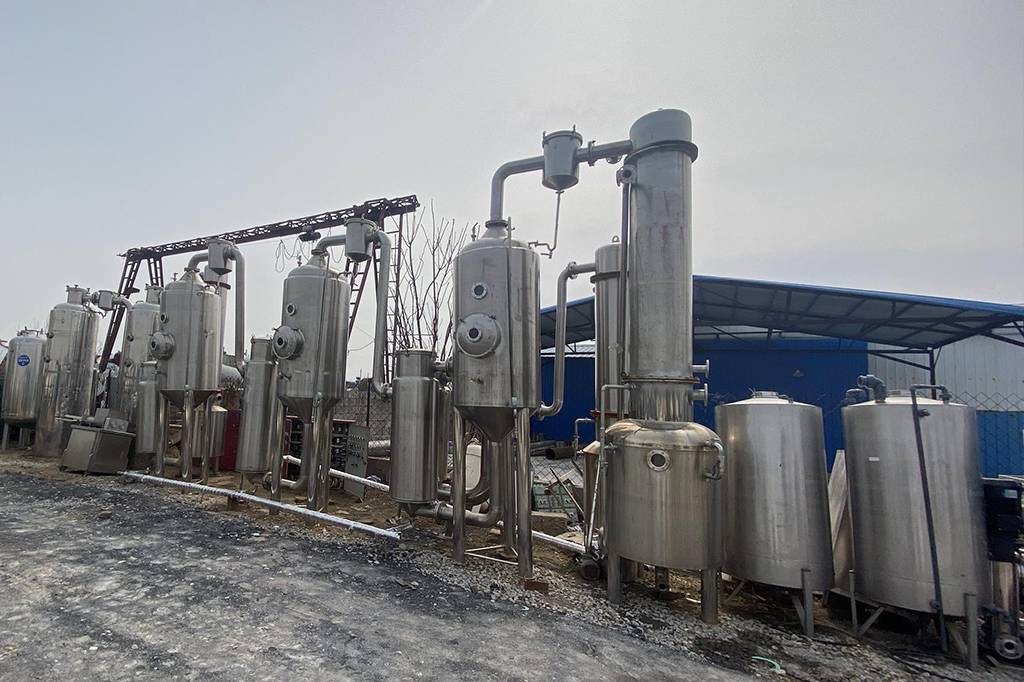
4. Footprint and Space Requirements
- Single Effect: Compact and suitable for facilities with limited space.
- Multi-Effect: Requires significantly more space, both vertically and horizontally, to accommodate multiple vessels and connections.
✅ Verdict: When space is limited, a single-effect system is often the better choice.
5. Application Scenarios
- Single Effect:
- Ideal for small-batch, variable-feed, or seasonal operations
- Common in pilot plants, wastewater pretreatment, or backup systems
- Multi-Effect:
- Best suited for continuous, large-scale processing
- Common in dairy, juice, chemical and zero liquid discharge (ZLD) systems
✅ Verdict: Select based on your production volume, energy goals, and process stability.
Conclusion
Both single effect evaporator and multi-effect evaporator play critical roles in modern process industries. If you prioritize simplicity, lower cost, and easy maintenance, the single-effect option is a reliable workhorse. If your goal is maximum energy efficiency and long-term operational savings, a multi-effect system may be worth the investment.