
When a biotechnology facility is expanding or upgrading, integrating new process equipment without disrupting ongoing production is always a challenge. One of the most strategic upgrades a plant can make is installing a mechanical vapor recompression (MVR) evaporator. But the key question is: how do you add this gear into a running biotech operation without causing downtime, risking contamination or losing yield? Let’s walk through practical steps and considerations to make the integration smooth, low-risk and value-adding.
Why consider an MVR evaporator in a biotech plant?
Before diving into the “how”, it’s worth reminding ourselves why an MVR evaporator is attractive for biotech operations. Some of the advantages include:
- Lower energy consumption: An MVR evaporator reuses latent heat from vapour rather than continually generating fresh steam, reducing utility costs.
- Smaller footprint / compactness: Some MVR systems can be more compact than traditional multi-effect steam evaporators, which helps when floor space is limited.
- Reduced steam and cooling requirements: That translates into less thermal stress on upstream/downstream systems.
- Versatility for handling sensitive streams: In biotech you often deal with liquids that must be handled gently (e.g., cell culture media, extracts, fermentation broths). An MVR evaporator can help reduce high-temperature exposure compared to some older systems.
Given these benefits, the goal becomes how to integrate such a system without disrupting your biotech plant’s critical operations.
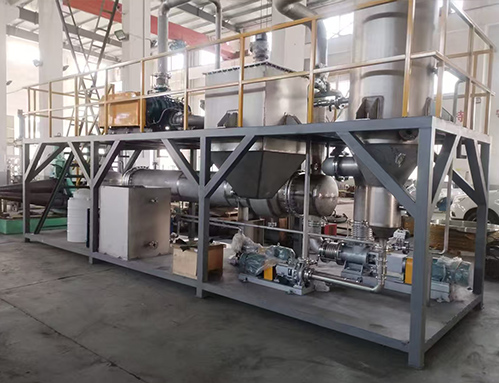
Step-by-step integration plan
Here’s a practical roadmap that you can adopt (and tailor) for your facility:
- Pre-feasibility and process audit
- Map out your current evaporation or concentration stage(s): feed stream composition (viscosity, solids, bio-sensitive components), flowrates, temperature/pressure conditions.
- Identify potential points of insertion (new line vs retrofit).
- Evaluate how an MVR evaporator would fit: what vapour source you’ll compress, what heating duty you’ll supply, what downstream effects (condensate, recycle, waste) occur.
- Define integration boundaries & isolation strategy
- Choose a location that allows the existing process to keep running while the MVR system is installed.
- Arrange “bypass loops” or temporary piping so you can isolate the new unit without halting upstream fermentation, downstream separation, etc.
- Confirm hygienic design: in biotech plants you must ensure no cross-contamination, CIP (clean-in-place) compatibility, GMP compliance if required.
- Engineering design & compatibility checks
- Material of construction: biotech streams may be aggressive or require sanitary finish; verify that the MVR unit meets those standards.
- Utility compatibility: The MVR may require compressed vapour or electrical power different from your current steam supply; ensure utility infrastructure (electrical, controls, piping) can accommodate.
- Control systems integration: Integrate the MVR’s instrumentation into your plant’s DCS/SCADA so that you maintain process visibility and control.
- Layout & logistics: Since your plant is running, plan crane usage, piping installation, instrumentation, and ensure safety clearances and hygienic access.
- Phased installation & commissioning without downtime
- Phase 1 – Off‐line assembly: Pre-assemble the MVR evaporator modules off to the side (if possible) to minimise plant disruption.
- Phase 2 – Tie-in work during scheduled window: Use a planned production lull (e.g., changeover or scheduled downtime) to perform tie-in of piping, utilities and controls.
- Phase 3 – Parallel run/test mode: Before switching the full load onto the new MVR, run it in parallel or partial load mode to verify parameters: vapour compression performance, outlet concentration, condensate return, hygienic performance.
- Phase 4 – Ramp up and hand-over: Once validated, switch the new MVR evaporator into full operation and retire the old system (if replacing) or shift process flows accordingly.
- Validation, monitoring and fine-tuning
- Monitor critical parameters: evaporation duty, energy consumption (steam/electric), concentrate quality (solids, activity/purity if biotech actives), hygiene metrics.
- Compare actual performance versus predicted (for example, expected reduction in steam demand, reduction in cooling water, reduction in footprint) to validate ROI.
- Execute maintenance programmes: Since you’re in a biotech plant, maintenance and cleaning schedules (CIP/SIP) are major risk points—document the new system’s cleaning protocols and include in your plant’s maintenance system.
Integration checklist
Here’s a handy table form you can keep as a checklist:
| Task | Key Questions |
|---|---|
| Feed stream audit | What are flow-rates, solids content, thermal sensitivity? |
| Utility compatibility | Can existing steam/electrical systems support the MVR? |
| Hygienic design | Does the MVR meet sanitary design / GMP standards? |
| Piping & layout plan | How will installation avoid major production disruption? |
| Control system integration | Will MVR controls tie into your DCS/SCADA? |
| Commissioning plan | Is a parallel run feasible? Is there a scheduled window for tie-in? |
| Monitoring & KPIs | What are energy use, concentrate quality, uptime targets? |
| Maintenance / CIP plans | Are cleaning protocols defined and integrated? |
Common pitfalls and how to avoid them
In my experience, the most common issues when integrating an MVR into a running biotech plant include:
- Underestimating utility upgrades: Often plants assume “plug the evaporator in”, but the electrical load, vapour handling, cooling circuits may require upgrades. Solve this by involving utilities engineering early.
- Production disruption from tie-in work: Without a proper plan, piping or crane work can force unplanned shutdowns. Mitigate by scheduling tie-ins during known windows and using off-site pre-assembly.
- Hygienic design mismatch: Biotech plants often have stricter sanitary requirements than industrial evaporators. Ensure the vendor understands pharma/biotech sector.
- Insufficient training: New equipment requires operators to learn new controls and maintenance regimes. Provide training and downtime for familiarisation before full load.
- Neglecting process variability: Biotech streams may vary in composition (e.g., fermentation broth vs extract) more than typical industrial feeds. Make sure the MVR has flexibility and control to handle variations.
Integrating an MVR evaporator into a biotech plant doesn’t need to be an after-thought or a risky “big bang”. With a structured approach—starting with feed/utility audit, isolating installation work, phased commissioning, and proper validation—you can achieve the twin goals of improved efficiency and minimal disruption. For biotech manufacturers looking to scale, save energy, improve sustainability and maintain product integrity, the addition of a well‐integrated MVR evaporator can be a smart strategic investment.