
When dealing with high-salinity wastewater — brines from electroplating, chemical processes, desalination concentrate, or salt-laden industrial effluent — using a MVR evaporator is among the most energy-efficient and sustainable choices. However, “efficient” doesn’t automatically mean “stable.” High salinity brings a host of challenges: scaling, corrosion, boiling point shifts, even potential shutdowns if the system isn’t properly managed. If you run an MVR for salty wastewater — stability must be actively maintained. Below is a playbook of best practices and design strategies to keep MVR systems robust under salinity stress.
Why High-Salinity Wastewater Is Hard on MVR Systems
- Boiling point elevation (BPE): As salt concentration rises, the boiling point of the solution increases. That means the temperature difference driving heat transfer narrows, reducing evaporation rate and stressing the heat-exchange surfaces.
- Scaling and salt precipitation: As water evaporates, dissolved salts often exceed their solubility and precipitate, forming scale on heat-exchange surfaces. This scale insulates the surfaces and severely reduces heat transfer — sometimes leading to blockages, fouling, or total system failure.
- Corrosion, especially with chlorides and aggressive ions: High-salinity wastewater often contains chloride, sulfates and other aggressive ions. In standard materials, these can corrode evaporator internals, shortening lifespan or causing leaks.
- Reduced evaporation capacity over time: Salt build-up, increased boiling point, fouling — all reduce the effective driving force of evaporation, and over time the output drops unless corrective action is taken.
Given these issues, leaving an MVR system “set and forget” when treating high-salinity streams is a recipe for poor performance or breakdown.
Key Measures to Ensure Stable MVR Operation Under High Salinity
Here are practical design and operational measures that help maintain stability and performance:
| Strategy / Measure | Purpose / Benefit |
|---|---|
| Use corrosion-resistant materials (titanium alloy, duplex stainless steel, specialized alloys) | Resists chloride/sulfate-induced corrosion; extends lifetime of exchangers and piping. |
| Adopt forced-circulation or robust circulation design rather than simple falling-film when salinity high | Ensures good mixing, avoids stagnant zones where salt crystallization would start; better handles dense brine and scaling tendency. |
| Pre-treat wastewater (e.g. filtration, remove hardness salts, organics, adjust chemistry) before feeding MVR | Reduces load of scale-forming ions (Ca²⁺, Mg²⁺, silicates, etc.), minimizes fouling potential, protects heat-exchange surfaces. |
| Regularly remove concentrated “mother liquor” / brine to avoid over-concentration | Prevents excessive BPE and salt saturation that drive scaling/fouling; keeps solution properties manageable. |
| Monitor key parameters: salinity, TDS, temperature, pressure, concentration factor, scaling indicators | Early detection of drift (e.g. rising TDS or reduced evaporation rate) allows timely corrective action — cleaning, dilution, pre-treatment adjustment, etc. |
| Schedule periodic cleaning / maintenance (mechanical cleaning, chemical wash, descaling) rather than letting scale build up uncontrolled | Maintains heat transfer efficiency, avoids irreversible fouling or corrosion damage; prolongs service life. |
| Combine MVR with appropriate post-treatment or crystallization stages when targeting zero-liquid-discharge (ZLD) or salt recovery | Allows salt separation in solid form, avoids dealing with extremely concentrated brine indefinitely — reduces stress on evaporator. |
| Use intelligent control systems (automatic control of temperature, flow, concentration; alarms for scaling risk or salt saturation) | Helps respond dynamically to feed fluctuations, prevents operator error or neglect — essential when feed salinity or composition changes over time. |
Real-World Example: When Good Design Meets Proper Operation
In a documented industrial case of treating high-salinity wastewater from manufacturing of high-salt-content chemical waste, engineers implemented an MVR + forced-circulation + pretreatment + corrosion-resistant material system. The result:
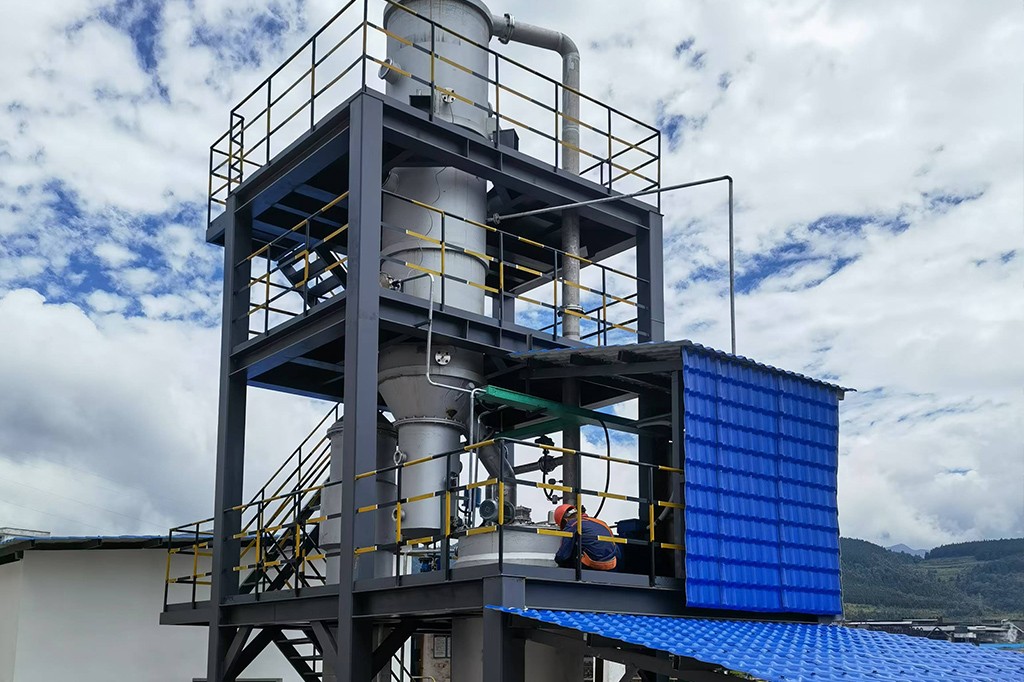
- Stable evaporation rates over extended operation cycles
- Energy savings compared to multi-effect evaporation or steam-based evaporation (because MVR reuses vapor heat)
- Salt concentrated and crystallized for discharge or reuse — aiding Zero Liquid Discharge (ZLD) compliance and minimizing wastewater footprint
This shows that with careful design and maintenance, MVR can be a robust, long-term solution — even for challenging high-salinity streams.
Common Pitfalls & What to Watch Out For
- Neglecting pre-treatment or using standard stainless steel when chloride content is high — leads fast to corrosion, leaks, or system failure.
- Using falling-film MVR for heavy brines / high salinity — often causes scaling, poor heat transfer, or uneven evaporation. Forced circulation is more appropriate.
- Allowing mother liquor to concentrate indefinitely (no regular discharge or dilution) — results in runaway salinity, BPE, and eventually scaling/inefficiency.
- Failing to monitor water chemistry over time — if input composition changes (e.g. more salts, different ions), system may destabilize without warning.
- Skipping scheduled maintenance — scale builds up into hard deposits, very difficult to remove; may require acid cleaning or even parts replacement.
Recognizing these risks early and planning around them is key to a stable MVR operation.
Conclusion — MVR Works in High-Salinity Wastewater — If You Manage It Smartly
MVR evaporators remain one of the best technological options for treating high-salinity wastewater — especially when zero-liquid-discharge, salt recovery, energy efficiency, or minimal external steam use are priorities. But “set and forget” won’t do. Success demands careful materials selection, pre-treatment, circulation design, operational vigilance, and routine maintenance.