
Walk into any food processing plant—juices, canneries, dairy, meat—there’s wastewater everywhere: rinse water, washdowns, extract residuals. These streams are rich in sugars, proteins, fats, and other organics, giving them high COD and lots of complexity. Evaporation ponds or simple biological treatment often can’t keep up. That’s where advanced evaporation steps in.
Food wastewater differs from many industrial streams because it’s mostly biodegradable and non-toxic, but it comes with surges, seasonal shifts, and lots of suspended solids. SMI’s evaporation machines are designed for food plants; they can outperform sprawling ponds by 10–14× in the same footprint.
Why Evaporation Works (and Why “Advanced” Matters)
- Volume Reduction
Evaporation concentrates the water out, leaving behind a smaller, more manageable waste stream. That translates to lower disposal cost, lower transportation burden. - High Quality Distillate
Vapor condenses into clean water (distillate) that can often be reused in cleaning, cooling, or other non-potable process uses. EVALED systems, for example, are used in food & beverage plants to treat and reuse factory effluents. - Energy Efficiency & Low Temperature
Advanced evaporation doesn’t mean high heat. By using vacuum, heat pumps, or mechanical vapor recompression (MVR), boiling happens at lower temperature, so thermal damage is minimized and energy reuse is maximized. Veolia highlights that such systems are being deployed across food, beverage, pharma, and more because they can cut volume while producing a high quality distillate. - Handling Complex Streams
Food wastewater often has fats, sugars, pulps, salts, cleaning agents. Advanced evaporators are designed to resist scaling, manage fouling, and tolerate variation. Condorchem’s technical guide on industrial vacuum evaporators discusses how to choose or design systems to handle different feed properties.
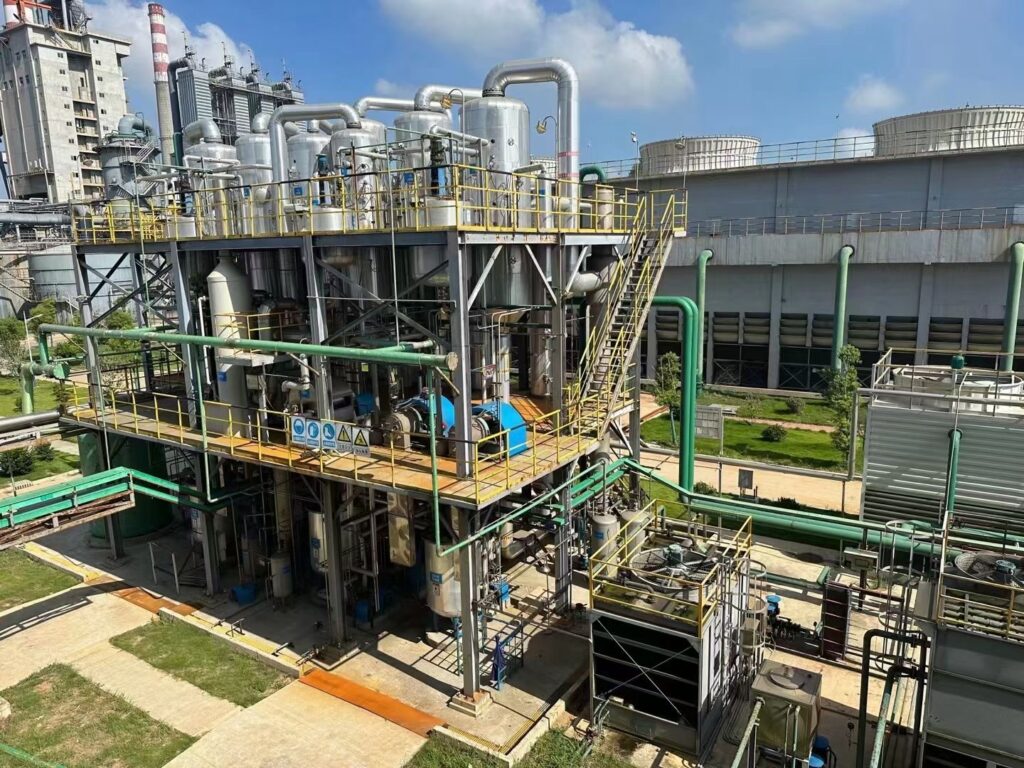
When You Put It Into a Workflow
Here’s how a food plant might use evap tech meaningfully:
- Pretreatment first — remove big solids, fats, settle or filter to reduce fouling.
- Evaporation stage — under vacuum or mild temperature, remove most water.
- Recompression or heat recovery — reuse vapor heat to reduce new energy burden.
- Distillate reuse — pipe that cleaned water back into the plant (rinse, coolers, etc.).
- Concentrated waste or solids disposal — what remains is much smaller and easier to handle.
As an example, in the food & beverage sector, EVALED systems treat effluents from dairy, beverages, fruit/vegetables canning, etc. The goal is to recycle water, recover by-products when possible, and shrink the discharge load.
Things to Keep an Eye On
- Scale & fouling: even mild feed can deposit salts, proteins.
- Material choice: food streams may have acids, sugars — stainless steels, corrosion-resistant coatings are important.
- Control & adaptability: feeds shift; your system must respond.
- Energy cost balance: electricity, heat, vacuum all factor in.
- Maintenance planning: access, cleaning, downtime all matter in a busy plant.
Food industry wastewater isn’t a dirty secret—it’s a resource opportunity. With advanced evaporation technology (especially low temperature / vacuum / MVR hybrids), plants can reclaim water, shrink waste, save cost, and stay in compliance. If you’re exporting these systems, showing you understand how to address food’s quirks will resonate with buyers.